


 January 30, 2026
How Small Game Studios Can Scale Without Large Development Teams
🎮 Introduction
Scaling a game studio no longer means hiring dozens of developers or burning massive budgets. In today’s game industry, small teams are building globally successful games by working smarter—not bigger.
Indie studios, solo founders, and compact development teams now have access to tools, workflows, and strategies that allow them to scale production, reach global audiences, and compete with much larger studios.
This guide explains how small game studios can scale sustainably without large development teams—and why this model is becoming the future of game development.
🧠 1. Focus on a Strong Core Game Loop
Scaling starts with clarity.
Successful small studios:
- Design one strong core mechanic
- Build depth around replayability
- Avoid feature overload early on
A well-polished core loop reduces:
- Development complexity
- Bug count
- Long-term maintenance cost
Great games don’t scale through size—they scale through focus.
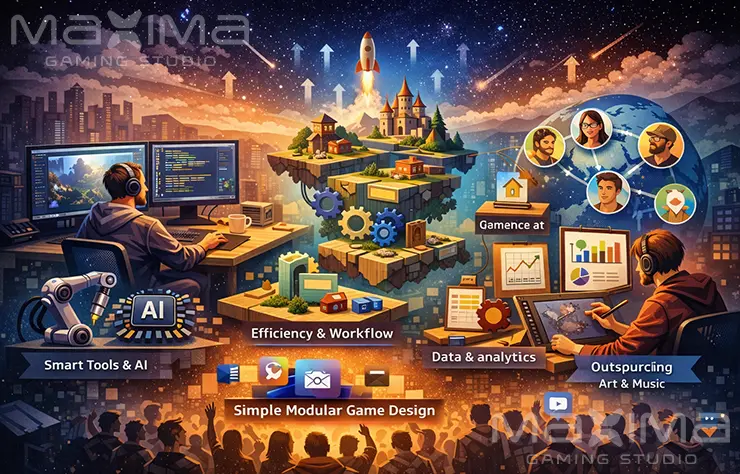
⚙️ 2. Use AI & Automation to Multiply Productivity
AI tools allow small teams to work like large ones.
Studios now use AI for:
- Code assistance and optimization
- Asset variations and concept art
- Procedural level generation
- Automated testing and QA
This dramatically reduces manual workload while increasing output quality.
AI doesn’t replace developers—it extends them.
🎨 3. Choose Stylized Art Over Realism
AAA realism requires AAA teams.
Smart indie studios:
- Use stylized or minimalist visuals
- Focus on clarity and identity
- Avoid heavy asset pipelines
Stylized games:
- Age better
- Are easier to optimize
- Require fewer artists
Players care more about identity than realism.
📦 4. Build Modular Systems, Not One-Off Features
Scalable studios build reusable systems.
Examples:
- Modular UI components
- Reusable level templates
- Shared animation controllers
This allows teams to:
- Add content faster
- Fix bugs globally
- Maintain consistency
Modularity = long-term scalability.
📊 5. Let Data Guide Growth Decisions
Small studios can’t afford guesswork.
Use analytics to:
- Track player drop-off points
- Identify broken onboarding
- Balance difficulty
- Improve retention
Data allows teams to scale strategically, not blindly.
📱 6. Optimize Early for Performance & Reach
Games that run everywhere grow faster.
Small studios should:
- Optimize for mid-range devices
- Keep download size low
- Reduce loading times
Performance optimization isn’t technical debt—it’s growth fuel.
🌍 7. Design for Global Scalability from Day One
Scaling globally doesn’t mean building separate games.
Instead:
- Use neutral themes
- Design localization-ready UI
- Avoid region-locked mechanics
Games built with global flexibility grow without rebuilding.
💰 8. Choose Sustainable Monetization Models
Scaling fails when monetization breaks trust.
Small studios succeed with:
- Battle passes
- Cosmetics
- Fair premium pricing
- Optional subscriptions
Ethical monetization keeps players longer—and reduces churn.
🤝 9. Outsource Smartly, Not Heavily
Small studios don’t need full-time teams for everything.
Outsource:
- One-time assets
- Audio or music
- Localization
- Specialized QA
Keep core design and gameplay in-house.
🧩 10. Build Community Before Scaling the Team
Community scales faster than headcount.
Studios should:
- Engage early players
- Collect feedback continuously
- Build trust and transparency
Strong communities:
- Improve retention
- Reduce marketing cost
- Guide development priorities
🔮 Why Small Teams Will Lead the Future of Gaming
The industry is shifting toward:
- Lean teams
- Smart tooling
- Player-driven development
- Continuous live updates
Size is no longer a competitive advantage—execution is.
🎯 Conclusion
Small game studios can scale without large development teams by focusing on clarity, automation, optimization, and smart design choices. The studios winning globally aren’t the biggest—they’re the most efficient.
With AI tools, modular workflows, ethical monetization, and data-driven decisions, small teams can now build games that reach millions.
In modern game development, smart beats big—every time.