


 December 25, 2025
Role of AI Tools in Mobile Game Development
Introduction
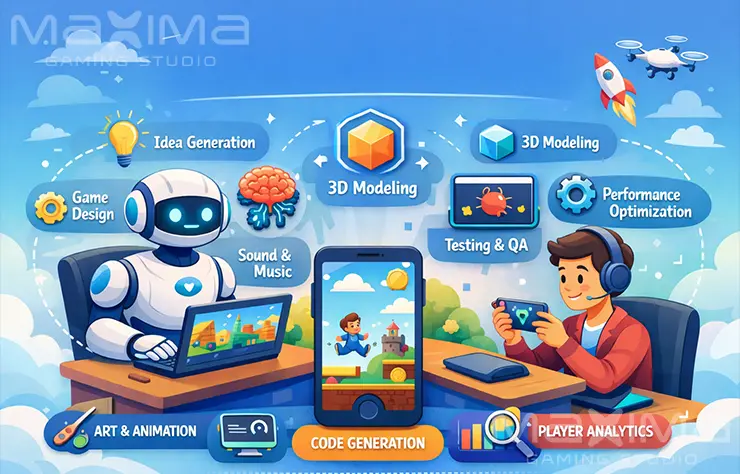
Mobile game development has evolved rapidly over the past decade. What once required large teams and long production cycles can now be achieved faster and more efficiently with the help of AI tools. In 2025, AI is no longer optional in mobile game development—it has become a core part of the creative and technical process.
From designing smarter gameplay mechanics to optimizing performance on low-end devices, AI tools are reshaping how mobile games are built, tested, and scaled.
1. Faster Game Prototyping & Idea Validation
AI tools help developers quickly turn ideas into playable prototypes.
They assist with:
- Auto-generating basic gameplay scripts
- Suggesting mechanics based on game concepts
- Rapid level block-outs
- Iterating ideas without heavy manual coding
This allows teams to test multiple concepts quickly and focus only on ideas that show real potential.
2. AI-Assisted Art, Animation & Asset Creation
Creating visual assets is one of the most time-consuming parts of mobile game development.
AI tools can:
- Generate concept art and character designs
- Assist in animation blending and motion prediction
- Create backgrounds, textures, and UI elements
- Speed up sprite and asset variations
This reduces production time while maintaining creative control.
3. Smarter Coding & Development Workflows
AI-powered coding assistants improve development speed and accuracy.
They help with:
- Writing and completing code
- Detecting bugs early
- Suggesting performance optimizations
- Refactoring scripts for mobile efficiency
This is especially valuable for mobile games where performance and battery usage matter.
4. Intelligent Level Design & Procedural Content
AI tools enable procedural generation tailored for mobile gameplay.
They can:
- Generate levels based on player behavior
- Balance difficulty dynamically
- Create endless or replayable content
- Prevent repetitive level design
This keeps players engaged without increasing manual design effort.
5. Player Behavior Analysis & Game Balancing
AI tools analyze player data to understand how users interact with the game.
They help developers:
- Identify drop-off points
- Adjust difficulty curves
- Balance rewards and progression
- Improve player retention
AI-driven insights allow data-backed design decisions instead of guesswork.
6. Automated Testing & Quality Assurance
Testing mobile games across multiple devices is challenging.
AI tools assist by:
- Simulating player behavior
- Detecting bugs and crashes
- Testing performance on various device profiles
- Reducing manual QA workload
This improves stability and speeds up release cycles.
7. Optimizing Monetization & Ads
AI helps optimize monetization without harming player experience.
It can:
- Predict player spending behavior
- Personalize in-app offers
- Optimize ad placement and frequency
- Balance revenue with retention
Smart monetization leads to sustainable growth.
8. Improving Performance on Low-End Devices
Mobile developers often target a wide range of hardware.
AI tools help:
- Optimize memory usage
- Reduce frame drops
- Adapt graphics settings dynamically
- Ensure smooth gameplay across devices
This is crucial for markets like India where device diversity is high.
Conclusion
AI tools are transforming mobile game development by speeding up workflows, improving quality, and enabling smarter design decisions. They empower developers to create engaging games with fewer resources and greater efficiency.
As AI continues to evolve, its role in mobile game development will only grow—shaping the future of how games are imagined, built, and experienced on mobile devices.