


 February 4, 2026
Mobile Game Development vs PC Game Development
Introduction
Game development today spans multiple platforms—but mobile and PC game development follow very different rules. While both aim to deliver engaging player experiences, the tools, design choices, performance constraints, and business strategies behind them vary significantly.
For studios, developers, and startups, choosing between mobile vs PC game development is a strategic decision—not just a technical one.
This guide breaks down the key differences between mobile and PC game development, helping you decide which platform best fits your goals.
Target Audience & Player Behavior
Mobile Game Development focuses on a mass-market audience with casual and mid-core players who prefer short play sessions of 5–15 minutes and frequent daily engagement.
PC Game Development targets a more niche but dedicated audience of core and hardcore gamers who enjoy long play sessions, deep immersion, and long-term progression.
Mobile focuses on accessibility and frequency, while PC focuses on depth and commitment.
Game Design & Complexity
Mobile games are designed around simple mechanics, easy onboarding, touch-based controls, and fast feedback loops.
PC games support complex systems, layered mechanics, and keyboard, mouse, or controller input with deeper learning curves.
Mobile design prioritizes speed and simplicity, while PC design prioritizes depth and control.
Graphics & Visual Expectations
Mobile games rely on optimized, stylized visuals where performance matters more than realism.
PC games push high-end visuals with advanced lighting, shaders, and high-resolution textures.
PC games can push visual boundaries, while mobile games must balance quality with device limitations.
Hardware & Performance Constraints
Mobile platforms face limited CPU and GPU power, battery and thermal constraints, and wide device diversity.
PC platforms offer higher processing power, more stable performance, and scalable hardware options.
Mobile developers spend more time on optimization, while PC developers focus more on feature richness.
Game Development Platforms & Tools
Both platforms often use the same engines, but the development focus differs.
- Unity, Unreal Engine, and Godot are commonly used across both platforms
- Mobile development emphasizes touch input systems, lightweight builds, and performance optimization
- PC development emphasizes advanced rendering, flexible input, and mod support
Game development platforms adapt differently depending on the target device.
Monetization Models
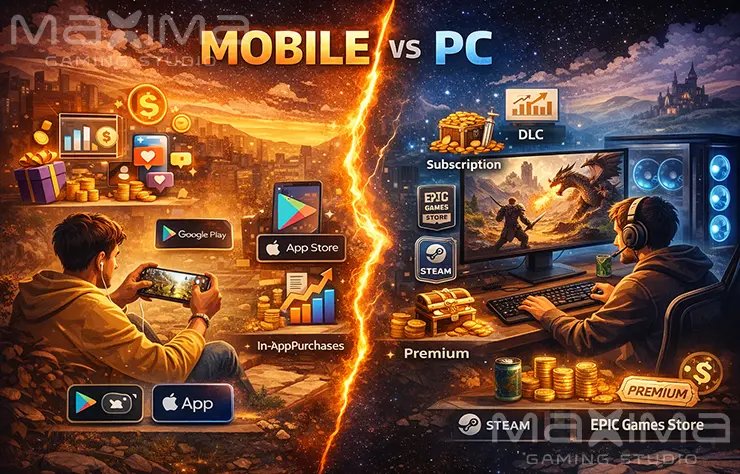
Mobile monetization is typically free-to-play, supported by in-app purchases, ads, rewarded videos, and battle passes.
PC monetization relies more on premium purchases, DLCs, expansions, subscriptions, and cosmetic microtransactions.
Mobile monetization relies on volume, while PC monetization relies on value per user.
Development Cost & Team Size
Mobile games are usually built by smaller teams with faster production cycles and lower entry costs.
PC games often require larger teams, longer timelines, and higher production budgets.
Mobile allows faster iteration, while PC demands higher upfront investment.
Updates & Live Operations
Mobile games depend on frequent updates, live events, and data-driven balancing.
PC games focus on larger content drops, community feedback, and less frequent patches.
Mobile games evolve continuously, while PC games evolve in milestones.
Distribution & Reach
Mobile games are distributed through app stores with instant global reach.
PC games rely on platforms like Steam and Epic Games Store with stronger community-driven discovery.
Mobile offers mass reach, while PC offers strong community loyalty.
Role of AI in Development
AI impacts both platforms in different ways.
Mobile AI focuses on player behavior analysis, retention optimization, and monetization personalization.
PC AI focuses on NPC intelligence, procedural world generation, and advanced simulations.
AI is more business-driven on mobile and more gameplay-driven on PC.
Choose mobile game development if your goals include large audience reach, faster growth, lower production costs, and live-ops driven revenue.
Choose PC game development if your focus is deep gameplay, premium positioning, long-term community building, and creative freedom.
Conclusion
The difference between mobile vs PC game development goes far beyond screen size. Mobile games prioritize accessibility, performance, and frequent engagement, while PC games emphasize depth, immersion, and technical power.
There is no better platform—only the right platform for your vision.
Studios that understand these differences can build smarter games, allocate resources efficiently, and succeed in competitive global markets.