


 February 5, 2026
Game Development Pipelines in 2026: From Idea to Live Updates
Introduction
Game development in 2026 is no longer a straight line from concept to launch. Modern games are living products—constantly updated, optimized, and refined based on player behavior and data.
Today’s successful studios rely on structured, flexible game development pipelines that allow small teams to move fast, adapt quickly, and scale efficiently. Whether you’re an indie developer or a growing studio, understanding the full pipeline—from idea to live updates—is essential.
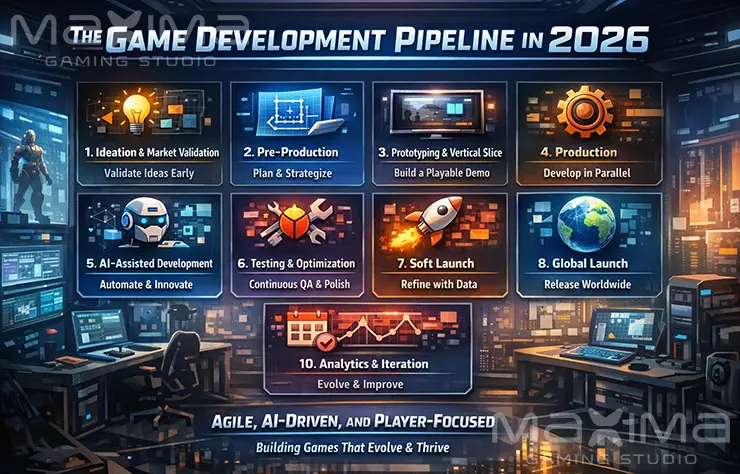
Let’s break down how game development pipelines work in 2026, step by step.
Ideation & Market Validation
Everything starts with the right idea—but ideas must be validated early.
- Identifying a clear player problem
- Analyzing market gaps and trends
- Studying competitor mechanics
- Defining the core gameplay hook
Instead of guessing, studios now validate ideas using small prototypes, community polls, and early concept testing. This reduces wasted development time later.
Pre-Production: Planning Before Building
Pre-production is where most success or failure is decided.
- Core gameplay loop definition
- Platform selection (mobile, PC, cross-platform)
- Art style and performance targets
- Technical architecture planning
In 2026, teams also choose monetization models early, design for scalability and live updates, and plan localization and accessibility. Strong pre-production keeps teams aligned and efficient.
Prototyping & Vertical Slice
Instead of building the full game, studios create a vertical slice.
- One complete gameplay loop
- Basic UI and controls
- Early visuals and animations
- Performance benchmarks
This helps teams test fun factor early, identify technical risks, and pitch internally or externally. Only validated concepts move forward.
Production: Modular & Parallel Development
Game production in 2026 is modular, not linear.
- Gameplay systems
- Art and animation
- UI/UX
- Audio and effects
Reusable systems, component-based design, and optimized asset pipelines allow faster development with smaller teams.
AI-Assisted Development & Automation
AI is embedded into modern pipelines.
- Code completion and optimization
- Procedural content generation
- Asset variations
- Bug detection
AI removes repetitive work, allowing developers to focus on creativity and polish.
Testing, QA & Performance Optimization
Testing is continuous—not a final step.
- Automated gameplay testing
- AI-driven player simulation
- Performance profiling across devices
- Crash and exploit detection
Optimization focuses on load times, memory usage, battery efficiency, and network stability.
Soft Launch & Data-Driven Refinement
Before global launch, games go through soft launches.
- Day-0 and Day-1 retention
- Session length
- Difficulty spikes
- Monetization behavior
Teams adjust onboarding, balance gameplay, and remove friction based on real data.
Global Launch & Distribution
Launch is treated as the beginning.
- Optimized store pages
- Influencer and creator outreach
- Region-specific messaging
- Scalable backend support
Live Ops: Events, Updates & Content Drops
Live operations are core in 2026.
- Seasonal events
- New levels or modes
- Balance patches
- Limited-time challenges
AI helps personalize content, schedule events, and predict churn.
Continuous Analytics & Iteration
Post-launch success depends on iteration.
- Player retention
- Engagement loops
- Community feedback
- Revenue health
Games evolve continuously—driven by data, not assumptions.
Conclusion
Game development pipelines in 2026 are built around speed, flexibility, and long-term growth. From idea validation to live updates, every stage is optimized for iteration and player-driven improvement.
Studios that master modern pipelines don’t just ship games—they build sustainable, evolving products.
Success today isn’t about how fast you build once—it’s about how well you keep building after launch.