

 December 26, 2025
Are AI Tools Worth Using? Benefits and Limitations
Introduction
AI tools are everywhere today—from writing and design to coding, analytics, and game development. Businesses, creators, and professionals are rapidly adopting them to save time and boost productivity. But a common question still remains:
Are AI tools really worth using, or are they just hype?
The answer isn’t black and white. AI tools offer powerful advantages, but they also come with clear limitations. Understanding both sides helps you decide when and how to use them effectively.
Let’s explore the real benefits and limitations of AI tools.
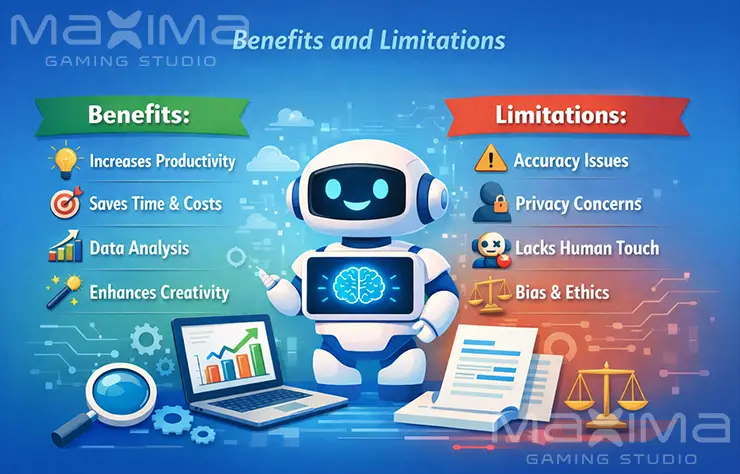
Benefits of Using AI Tools
1. Saves Time and Increases Productivity
AI tools automate repetitive and time-consuming tasks such as:
- Writing drafts
- Editing content
- Data processing
- Code completion
- Testing and debugging
This allows users to focus on high-value work like creativity, strategy, and decision-making.
2. Improves Efficiency and Accuracy
AI reduces human error by:
- Detecting inconsistencies
- Flagging mistakes early
- Analyzing large datasets quickly
In areas like analytics, coding, and testing, AI tools can be faster and more accurate than manual processes.
3. Makes Advanced Skills More Accessible
AI tools lower the entry barrier for many skills.
They help:
- Non-designers create visuals
- Non-coders build logic and scripts
- Small teams compete with larger organizations
This democratization of technology empowers individuals and startups.
4. Speeds Up Innovation
By handling routine work, AI frees up time for experimentation.
Developers and creators can:
- Test ideas faster
- Iterate quickly
- Launch products sooner
This leads to faster innovation cycles across industries.
5. Scales Easily with Growing Needs
AI tools can scale without needing proportional increases in manpower.
As workload grows:
- AI handles higher volumes
- Performance remains consistent
- Costs stay manageable
This makes AI especially valuable for growing businesses.
Limitations of AI Tools
1. Lack of True Human Understanding
AI tools process patterns—not emotions, ethics, or deep context.
They may:
- Misinterpret intent
- Produce generic or incorrect outputs
- Miss cultural or emotional nuance
Human judgment is still essential.
2. Output Quality Depends on Input
AI tools are only as good as the instructions given.
Poor prompts can lead to:
- Inaccurate results
- Irrelevant content
- Misleading conclusions
Users still need skill and clarity to get good results.
3. Data Privacy and Security Concerns
AI tools often process sensitive data.
Risks include:
- Data misuse
- Lack of transparency
- Compliance issues
Businesses must carefully evaluate privacy policies before adoption.
4. Risk of Over-Reliance
Relying too heavily on AI can:
- Reduce critical thinking
- Limit creativity
- Create dependency
AI should assist—not replace—human expertise.
5. Cost vs Value Mismatch
Not all AI tools deliver value equal to their cost.
Some tools:
- Offer features you don’t need
- Require ongoing subscriptions
- Provide limited real-world impact
Choosing the wrong tool can waste resources.
So, Are AI Tools Worth Using?
Yes—when used wisely.
AI tools are most valuable when:
- Solving specific problems
- Assisting skilled users
- Integrated into existing workflows
- Combined with human oversight
They are not magic solutions, but powerful productivity enhancers.
The Right Approach to AI Adoption
To get the best results:
- Start with clear goals
- Test tools before committing
- Use AI as a support system
- Continuously review output quality
This balanced approach ensures AI adds value without introducing risk.
Conclusion
AI tools are worth using—but only when their strengths and limitations are clearly understood. They excel at speed, automation, and efficiency but still depend on human intelligence for creativity, ethics, and decision-making.
When used responsibly, AI tools become powerful allies—helping individuals and businesses work smarter, innovate faster, and stay competitive in an evolving digital world.