


 December 26, 2025
How AI Is Shaping the Future of Gaming Industry?
Introduction
The gaming industry has always evolved alongside technology—but no innovation has had as much impact as Artificial Intelligence (AI). What started as simple enemy behavior scripts has grown into intelligent systems that can design levels, adapt gameplay, personalize experiences, and even create stories.
In 2025, AI is not just enhancing games—it is reshaping the entire gaming industry, from development and testing to player engagement and monetization.
Let’s explore how AI is defining the future of gaming.
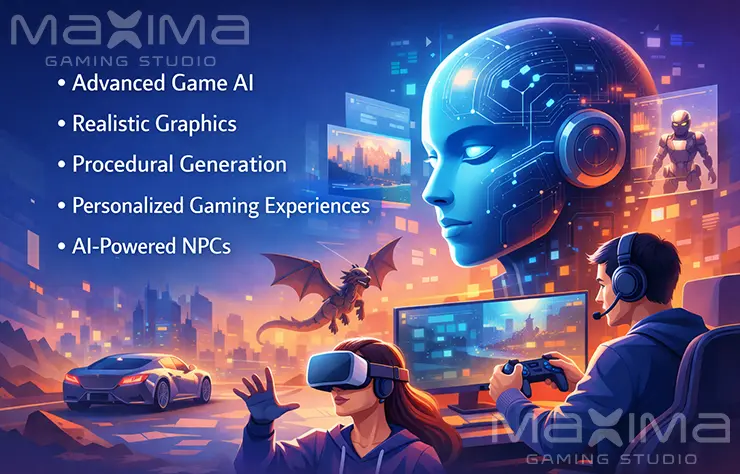
1. Smarter and More Realistic Game Characters
AI has transformed how characters behave in games.
Modern AI-driven NPCs can:
- React dynamically to player actions
- Learn from player behavior
- Show emotional responses
- Make independent decisions
This makes in-game characters feel more alive, believable, and immersive—moving far beyond predictable scripted behavior.
2. Personalized Gaming Experiences
AI allows games to adapt to individual players.
With AI-driven personalization:
- Difficulty adjusts based on player skill
- Content changes according to play style
- Rewards are tailored to engagement levels
- Tutorials adapt to player learning speed
This ensures every player gets a unique experience, increasing satisfaction and retention.
3. Procedural Content Generation
AI-powered procedural systems generate content dynamically.
This includes:
- Levels and maps
- Missions and quests
- Items and environments
- Endless gameplay variations
Procedural generation reduces development time while keeping games fresh and replayable.
4. Faster and Smarter Game Development
AI tools are accelerating development workflows.
They help with:
- AI-assisted coding
- Bug detection and optimization
- Automated testing
- Asset generation
This allows developers to build high-quality games faster and with smaller teams.
5. Improved Game Testing and Quality Assurance
Testing complex games manually is time-consuming.
AI improves QA by:
- Simulating thousands of player behaviors
- Identifying crashes and performance issues
- Testing across multiple devices
- Reducing human error
This leads to more stable and polished game releases.
6. Data-Driven Game Design and Balancing
AI analyzes player data to improve gameplay design.
Developers use AI to:
- Identify drop-off points
- Balance levels and rewards
- Improve engagement loops
- Optimize progression systems
This ensures games remain fun, fair, and engaging.
7. Smarter Monetization Without Hurting Experience
AI enables ethical and effective monetization.
It helps by:
- Predicting player spending behavior
- Personalizing in-game offers
- Optimizing ad placement
- Balancing revenue with player satisfaction
This creates sustainable business models while respecting players.
8. AI in Visuals, Animation, and Audio
AI assists creative production by:
- Generating realistic animations
- Improving character movements
- Creating adaptive music and sound effects
- Enhancing visual realism
These advancements make games more immersive without significantly increasing production costs.
9. AI Making Games More Accessible
AI improves accessibility by:
- Supporting voice commands
- Offering adaptive controls
- Assisting players with disabilities
- Providing real-time translation and localization
This expands gaming to a wider and more inclusive audience.
The Future of AI in Gaming
In the coming years, AI will:
- Drive fully adaptive game worlds
- Enable intelligent storytelling
- Create emotional, responsive NPCs
- Automate large parts of development pipelines
Games will evolve from static experiences into living systems that respond intelligently to players.
Conclusion
AI is shaping the future of the gaming industry by making games smarter, more personal, more efficient to build, and more immersive to play. It empowers developers to innovate faster while delivering richer experiences to players.
As AI continues to evolve, gaming will no longer be just about playing—it will be about interacting with intelligent worlds that grow alongside the player.