


 December 20, 2025
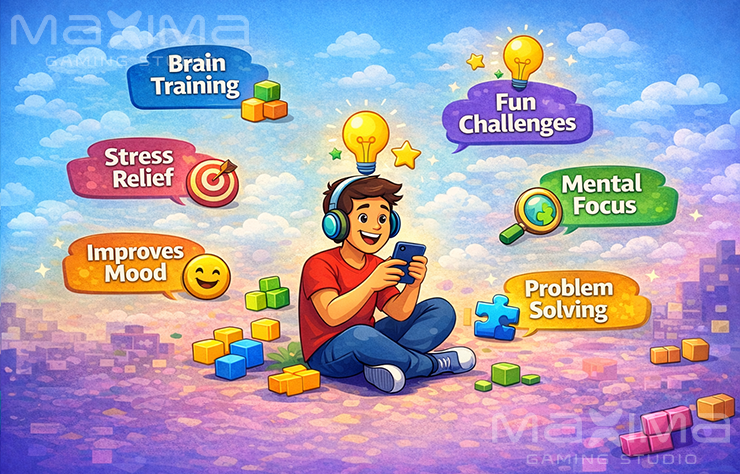
How Puzzle Games Improve Brain Power & Focus
Introduction
Puzzle games are often seen as simple time-pass entertainment, but in reality, they are powerful tools for mental stimulation. From classics like Sudoku and Crossword to modern mobile hits like Candy Crush, Monument Valley, and Brain Out, puzzle games challenge the brain in ways that few other genres can.
In 2025, with increasing screen time and constant distractions, puzzle games are gaining popularity not just for fun—but for improving brain power, focus, and cognitive skills.
Let’s explore how puzzle games actively train the mind.
1. Strengthening Problem-Solving Skills
Every puzzle presents a challenge that requires logic, pattern recognition, or strategic thinking.
Players learn to:
- Analyze situations
- Try different solutions
- Learn from mistakes
- Think creatively under constraints
Over time, this repeated problem-solving strengthens the brain’s ability to handle complex situations, both in games and real life.
2. Improving Focus and Concentration
Puzzle games demand attention.
To solve a puzzle, players must:
- Focus on details
- Avoid distractions
- Maintain concentration for extended periods
Unlike fast-paced action games, puzzle games encourage calm, deep thinking. Regular play helps train the brain to stay focused longer, improving attention span.
3. Boosting Memory and Recall
Many puzzles rely on remembering:
- Patterns
- Sequences
- Rules
- Previous attempts
This constant memory use improves:
- Short-term memory
- Working memory
- Information recall speed
Games like memory matching or logic-based puzzles are especially effective for mental retention.
4. Enhancing Logical Thinking & Reasoning
Puzzle games strengthen logical reasoning by forcing players to connect clues and predict outcomes.
Examples:
- Sudoku improves numerical logic
- Tile-matching games enhance pattern recognition
- Escape-room puzzles build deductive reasoning
These skills directly transfer to real-world tasks like decision-making and planning.
5. Reducing Stress While Training the Brain
Puzzle games offer a calm, pressure-free environment.
Benefits include:
- Reduced anxiety
- Improved mood
- Mental relaxation
When the brain is relaxed, it learns more efficiently. This balance of challenge and calm makes puzzle games ideal for mental wellness.
6. Encouraging Patience and Persistence
Not every puzzle can be solved instantly.
Players learn:
- Patience
- Trial-and-error thinking
- Persistence after failure
These traits help build mental resilience and improve emotional control over time.
7. Ideal for All Age Groups
One of the biggest strengths of puzzle games is accessibility.
They are:
- Easy to start
- Difficult to master
- Suitable for kids, adults, and seniors
This makes puzzle games a universal brain-training tool across generations.
8. Puzzle Games vs Traditional Brain Exercises
Unlike textbooks or formal exercises, puzzle games:
- Are interactive
- Provide instant feedback
- Keep users engaged longer
- Feel rewarding instead of tiring
This makes them more effective for consistent mental training.
9. The Future of Puzzle Games & Cognitive Health
With AI integration, future puzzle games will:
- Adapt difficulty to player skill
- Track cognitive improvement
- Personalize challenges
Puzzle games are evolving into smart mental fitness platforms.
Conclusion
Puzzle games are far more than casual entertainment. They sharpen the mind, improve focus, enhance memory, and encourage thoughtful problem-solving—all while remaining enjoyable and stress-free.
In a world full of distractions, puzzle games offer something valuable: a fun way to train the brain and stay mentally sharp.